
The Faculty of Human and Social Sciences at Üsküdar University organized the “Faculty of Human and Social Sciences Student Conference.” The conference emphasized the importance of transforming 21st-century competencies into concrete projects by integrating mathematics and statistics into the social sciences. It featured three sessions titled “Gender, Power, and Representation,” “History and Social Transformation,” and “Current Research in Psychology.” Prof. Dr. Nevzat Tarhan, Founding Rector of Üsküdar University, also attended the conference, where students presented projects they had prepared across various disciplines and shared their work in diverse fields of the social sciences.

The conference, held in the Fuat Sezgin Conference Hall at Üsküdar University’s South Campus, was attended by Üsküdar University’s Founding Rector, psychiatrist Prof. Dr. Nevzat Tarhan, and the Dean of the Faculty of Human and Social Sciences, Prof. Dr. Deniz Ülke Kaynak, along with many other academics and students.

Prof. Dr. Nevzat Tarhan, Founding Rector of Üsküdar University and a psychiatrist, who did not leave the students behind and spoke at the conference’s opening, emphasized project-based learning. Tarhan stated, “When the social sciences and mathematics come together, the social sciences become a science. Social events and social data will merge with mathematics. When combined with statistics, they become science, articles, projects, and publications. Therefore, it is important to have knowledge of statistics and to address any gaps in this area. Beyond research methods, it is beneficial for those involved in projects to improve their statistical skills—even if they do not become statisticians. This ensures the measurability and testability of our work. We’re doing original work—work with a broad impact—but what makes it scientific is its measurability and sustainability. That’s why project planning provides us with this. You’re placing the work you do within a logical framework. Everything that enters the “laboratory of the mind” is something for which a scientific causal link has been established, verified, and tested. Napoleon once said three things: “Money, money, money.” Now we say, “Project, project, project,” he remarked.

Tarhan, noting that young people who want to leave a lasting impact in the future must operate within a project-based discipline, said: “Those who prioritize projects will make a difference in the future. If you want to stand out among your peers in the future, you must move forward by structuring and organizing your work into projects. Also, we cannot manage work that we cannot measure. We must measure it first, and only then can we manage it. In other words, it’s important to try to measure everything we do. Looking at a situation mathematically means knowing where to stop and learning the boundaries of freedom and responsibility. It means learning the boundaries between right and wrong, and between good and bad. In other words, wherever we apply mathematics, it helps us find the truth and reach reality,” he said.

Prof. Dr. Deniz Ülke Kaynak, Dean of the Faculty of Human and Social Sciences at Üsküdar University, spoke in her opening remarks about the transformation of universities throughout history and the 21st century’s new project-oriented approach to education. Kaynak said, “We have undertaken numerous initiatives at our university to instill a project culture. In addition to the ‘Project Culture’ course, we have begun to place special emphasis on graduation projects. We have placed great importance on our faculty members generating projects and carrying them out together with students. When the first universities emerged in Europe in the 1200s, the fundamental educational philosophy and format were largely based on transmitting church teachings to new generations. However, in the 19th century, with the model developed by Wilhelm von Humboldt, universities began to incorporate research as an integral part of their curricula and areas of activity. Thus, the university had to become an institution that not only teaches but also generates knowledge, conducts research for the sake of knowledge, and represents new frontiers in science. In the 21st century, another important characteristic was added to this. Universities have now become institutions capable not only of education and research but also of production, developing projects, and transforming these projects into value. “The process of taking ideas—which take shape following laboratory work—and transferring them to the business world, along with the creation of a project ecosystem around this process, has also become an important part of the university’s new mission,” he said.

Referring to Üsküdar University’s commitment to the basic sciences, Prof. Dr. Deniz Ülke Kaynak said, “In Turkey, the importance placed on the teaching of basic sciences—particularly disciplines like Philosophy, History, and Sociology, which are oriented more toward the production of genuine knowledge rather than finding jobs in the job market—has been steadily declining. However, we are very mindful of this issue and are placing the basic sciences at the heart of our university by strongly supporting them. We view our Faculty of Humanities and Social Sciences as one of the cornerstones of this approach. In addition, we adopt an approach that encourages projects and research. In other words, we have actually created a synthesis. This Student Congress, which we are organizing for the first time, is a product of this synthesis aimed at involving our students in this philosophy. God willing, we will continue in the same vein in the coming years,” he said.
Following the opening remarks, the event moved on to project presentations.

The conference’s first session began under the title “Gender, Power, and Representation.”
The session was chaired by Prof. Dr. Barış Erdoğan, Chair of the Sociology Department.

During the session, Selin Nur Şartepe and Gözde Akdoğan, students in the Department of Political Science and International Relations, presented “The Relationship Between Women, Politics, and Power”; Beyzanur Kaplan, a student in the Department of Radio, Television, and Cinema, presented “Women in the Shadow of the Lens: Cinema’s Invisible Workers,” and Elif Mina Seyyidoğlu and Azra Bos, students from the Department of Sociology, presented their project titled “A Field Study on Domestic Violence and Power Dynamics.”

The conference’s second session began under the title “History and Social Transformation.”
The session was chaired by Prof. Dr. Hadiye Yılmaz, Chair of the History Department.

In this context, Adem Büyükyiğit, a student in the Department of History, presented “The Steppe Strategy and the Ottoman Order: The Battle of Ankara,” while Ömer Kütük, also a student in the Department of History, presented “Power Struggles in Ottoman Scholarly and Administrative Circles: The Struggle Between the Minkarizade and Köprülü Schools,” Public Relations and Promotion Department student Sümeyye Coşkun presented her project titled “The Historical Transformation of Women’s Social Status in Middle Eastern Societies,” Deniz Delice, a student in the Radio, Television, and Cinema Department, presented her project titled “Psychological and Physical Pressures on Men Throughout History.”

The third session of the conference began under the title “Current Research in Psychology.”
The session was chaired by Dr. Hazal Ayas, Assistant Professor and Chair of the Department of Psychology.

As part of this session, Psychology Department student Yaşar Ahmet Yeşil presented “An Investigation of the Effects of Social Isolation and Environmental Enrichment on Cognitive Bias in Female and Male Rats,” and (English) Department student Ayşe Semi Olutaş presented “Neurobiological Foundations of Emotion Regulation,” Psychology Department student Esranur Kutlar, “The Relationship Between Digital Addiction and Parental Attitudes in Children and Adolescents.”

At the end of the conference, Üsküdar University Founding Rector and Psychiatrist Prof. Dr. Nevzat Tarhan presented books to the students who presented their projects.
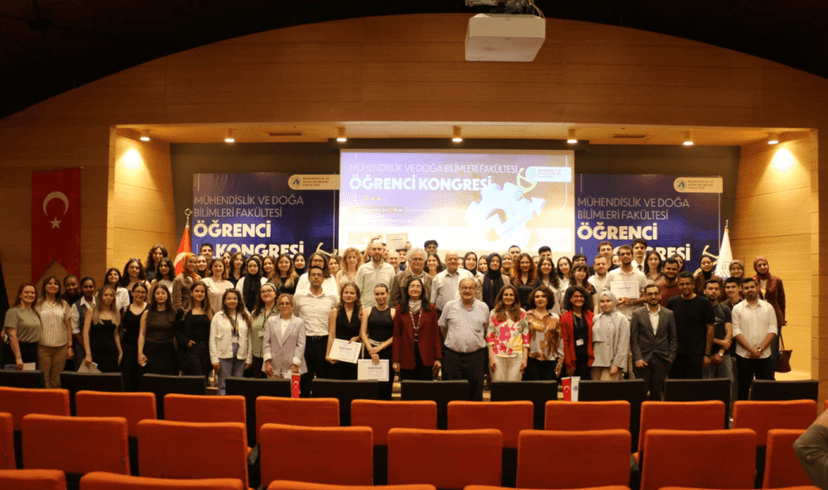
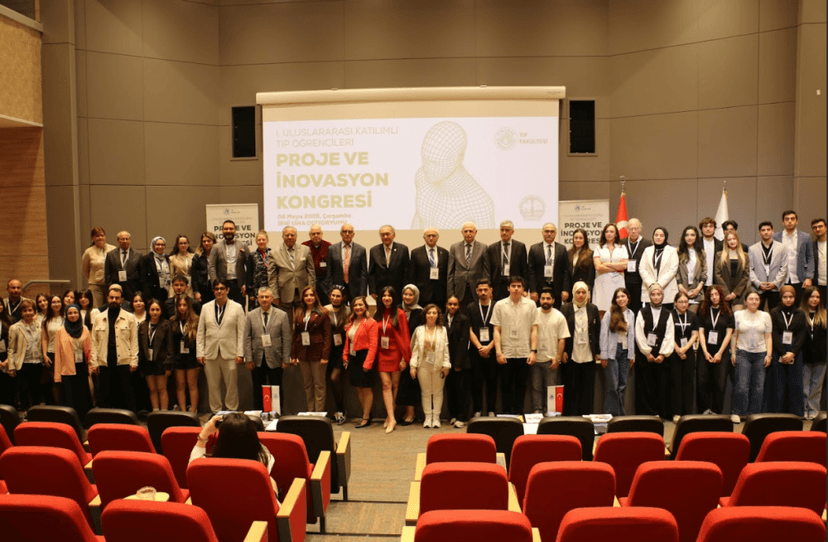
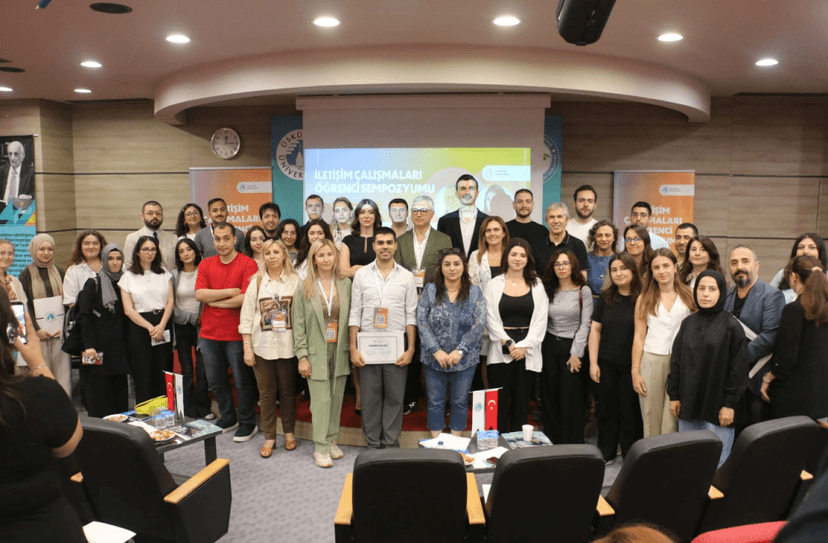
The student conference concluded with a group photo.
Üsküdar News Agency (ÜHA)